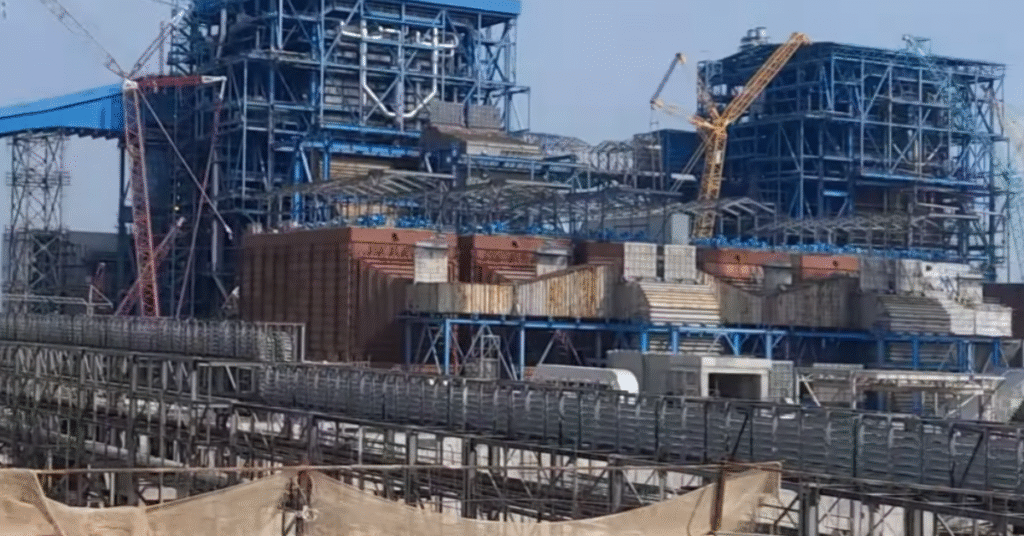
Buxar Thermal Power Plant is the biggest thermal project in Bihar whose first 660 MW unit started in 2025. Know its history, cost, capacity, jobs impact and its effect on Bihar’s energy security.
Introduction
New flight in Bihar’s power sector
This is a historic moment for Bihar—the virtual inauguration of the first 660 MW unit of Buxar Thermal Power Plant has now been officially done! Prime Minister Narendra Modi inaugurated it from Gaya itself, and now the first unit has started power generation. This blog post will explain in detail in Hinglish the various aspects of this plant—history, cost, tech, impact.
Origin of the project: When and how it started
Conceptualization In 2013, SJVN signed an MoU with Bihar State Power Holding Company (BSPHCL)—that’s when the vision of the Buxar plant began. Foundation Stone Prime Minister Modi virtually laid the foundation stone of this plant on March 9, 2019, when Union Energy Minister R.K. Singh was also present. Construction Timeline In June 2019, Larsen & Toubro (L&T) was made the EPC (Engineering, Procurement, Construction) contractor, NTPC was given the role of PMC, and RITES was given the task of managing railway connectivity.
Investment Journey
Initial Estimate Cabinet Committee on Economic Affairs (CCEA) had approved ₹10,439 crore for this project for 2023–24.
Escalated Cost
According to Times of India and local sources, the project cost has now reached ₹14,390 crore, due to delays and logistical challenges. But according to sources like Economic Times and ProjNewstime, the “final” investment figure is ₹13,756.56 crore.
Summary Investment Estimates Table
| Source | Estimated Cost (₹ Crore) |
|---|---|
| CCEA initial approval | 10,439 |
| Times of India (current) | 14,390 |
| Economic Times / others | 13,756.56 |
This means—cost overruns have been significant (₹3,300–4,000 crore more than initial expectations). This has happened because of delays and supply chain issues.
Inauguration and Launch Event
Virtual Inauguration PM Modi virtually inaugurated the event from Gaya; Bihar Governor, CM Nitish Kumar and SJVN officials were also present at the event. Distribution power is being supplied directly to grid stations—Patna, Karmanasha, Dehri-on-Sone. This launch was also a part of a larger megaproject—where several projects like energy, tourism, urban development, industrial corridor were launched simultaneously in Bihar.
Operational Requirements (Coal, Water & Security)
To run the Coal Plant, 7,000 tonnes of coal is required daily. Daily Water: Aur 55 cubic meters of water is consumed daily. Security Measures Security remained very tight during construction—CISF internal security, local police external, drone ban, identity checks of 7,000 daily-wage laborers mandatory—especially in the background of India-Pakistan tensions.
Jobs & Industrial Impact
Employment: The project provided direct and indirect employment to 10,000 people. According to an alternate estimate, 5,000 workers were annually involved during construction, while local services—transport, markets, hotels, small businesses—also benefited. Domestic Industry Boost Reliance increased significantly—2,54,932 MT steel and 2,80,362 tonnes cement—all from domestic sourcing, supporting the Atmanirbhar Bharat initiative.
Allocation & Regional Significance
Power Allocation 85% electricity allocated to Bihar under long-term PPA—major boost for state’s energy security 15% power under central pool goes to Odisha, Assam, Sikkim. Regional Impact Bihar and eastern region’s peak-hour shortages will majorly reduce; Energy supply will be secure. This plant will attract industrial investments and infrastructure developments—especially in Magadh region, where it will get political and economic uplift.
Future Plans & Expansion Vision
Second Unit (660 MW): Will be commissioned by 2026, total capacity of the plant will be 1,320 MW. Future Expansion (1,980 MW): The Government proposal includes a plan to expand the plant to 1,980 MW by adding one extra unit. This expansion is expected to provide more energy supply and regional benefits.
SJVN – Developer Profile
Company Background SJVN (Satluj Jal Vidyut Nigam Limited) is a Navratna PSU, jointly owned by Government of India (~60%) and Government of Himachal Pradesh (~27%).
Portfolio
Primarily hydroelectric projects—Nathpa Jhakri (1500 MW), Rampur (412 MW), etc. Now diversified into thermal (Buxar), solar, wind and transmission projects across India and in Nepal & Bhutan. Through this project SJVN is strengthening its thermal footprint, especially in eastern India.
Conclusion
Bihar is now getting the opportunity to fulfil its power needs majorly on its own. Reliable electricity supply will make new factories, industries, infrastructure projects feasible. From construction to operations, the jobs and business ecosystem is proud. Efficiency better with supercritical tech; environmental impact slightly under control. The roadmap for expansion from 1,320 MW to 1,980 MW seems future-proof.
FAQ’s
-
Where is Buxar Thermal Power Plant located?
Buxar Thermal Power Plant is located on the banks of Ganga river in Chausa block, Buxar district of Bihar.
-
What is the total capacity of this plant?
The total capacity of the plant is 1320 MW, which is divided into two units—each one of 660 MW.
-
What is the cost of this project?
The initial estimate was ₹10,439 crore, but now the project cost has reached ₹13,756 – ₹14,390 crore.
-
Where will the power generated from this plant be supplied?
85% electricity will be provided to Bihar and 15% will be provided to Odisha, Assam and Sikkim through central pool.
-
How much coal and water is required daily?
Approximately 7,000 tonnes of coal and 55 cubic metres of water is required daily.
-
What impact will this project have on local employment?
Approximately 10,000 people have got direct and indirect employment and local businesses, industries and services are also benefiting from it.