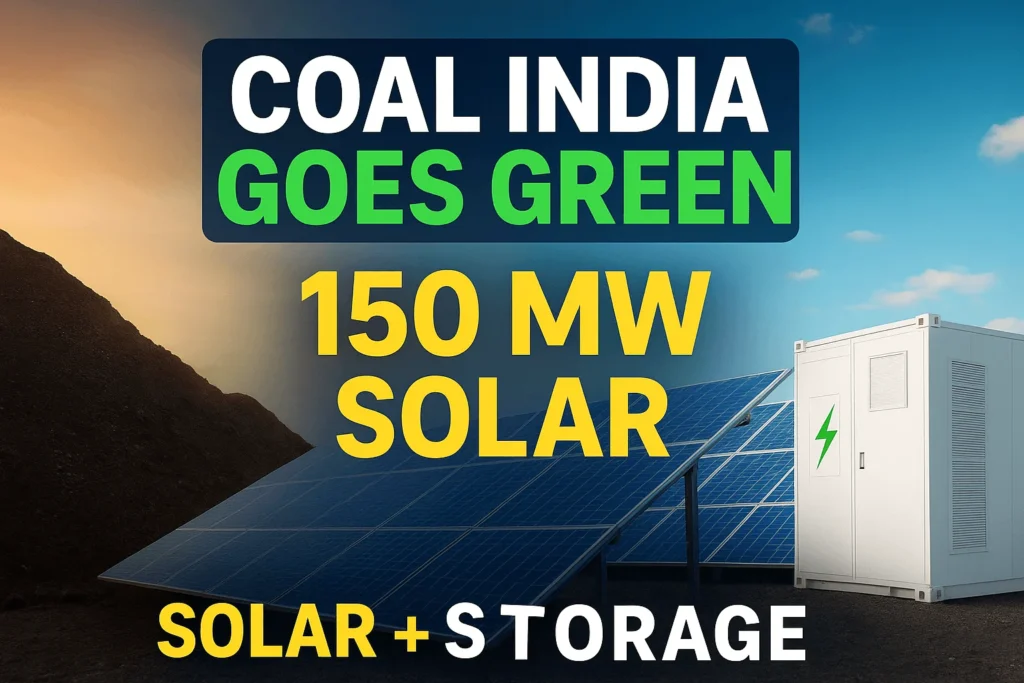
Coal India Limited has entered the renewable energy sector. The company is preparing to set up a 150 MW Solar PV project with Battery Storage (BESS). Know the complete details, strategy, challenges and possibilities.
Coal India Limited Entry into Renewable Energy: 150 MW Solar PV + Battery Storage Project
Coal India Limited (CIL), a major public sector undertaking under the Ministry of Coal, is now preparing to enter the Renewables sector after coal. Through an Expression of Interest (EOI) issued in September 2025, they have proposed a 150 MW Solar PV project + Battery Energy Storage System (BESS). In this article, we will discuss in detail all the important aspects of this project, technical requirements, strategy and its potential impact.
Project Basics
Project Capacity: 150 MW of Solar PV power, which will be connected to ISTS-(Inter-State Transmission System). Battery Storage System (BESS): BESS will be mandatory for this project. The tender specifies that there should be at least 0.5 MW BESS for every 1 MW solar capacity. Apart from this, the system should be capable of providing adequate power during peak hours, i.e., about 3 MWh per MW should be designed.
Tender / EOI Process: CIL has issued an EOI on 4th September 2025, so that interested EPC (Engineering, Procurement, Construction) contractors can submit their capability. The big expectation from this EOI is that further formal tender documents will be prepared, which are in line with SECI-ISTS-XXI tender.
Technical & Land Requirements
Overall, the following are the technical / land & regulatory requirements for this project:
EPC Model: The project will be run completely under EPC – i.e. the EPC contractor will be responsible for engineering, procurement, supply, installation, testing, commissioning etc.
Land Bank: There should be sufficient land bank to accommodate 150 MW solar plant + BESS + pooling sub-station and other required infrastructure.
ISTS Connection: The plant must be connected to ISTS at a minimum of 220 kV voltage level.
Other important points:
- Revised GST rates applicable on Renewable Energy devices and related works are to be taken into account.
- Regulatory standards to be followed to ensure quality, performance obligations, and grid stability.
- The model will also entrust the responsibility of long-term operation & maintenance (O&M) to the EPC partner.
Strategic meaning and examples
Coal India’s move is not just a renewable project, but an indication of how traditional energy companies are moving towards diversifying their business in the future. Some of its key strategic aspects:
Diversification: CIL is now looking to increase its share in clean energy through solar + storage instead of relying only on coal mining and grey energy. This will also help in meeting India’s clean energy targets.
Policy Alignment: Complying with the tender issued by SECI and SECI-ISTS-XXI specifications, indicates that the project will be in line with the policy and regulatory framework. This can ease approval and grid-connectivity etc.
Grid Stability: The battery storage component is designed in such a way that the grid gets support during peak load, reducing the risk of intermittency of renewables.
Challenges and opportunities
Every big scheme comes with some challenges, but opportunities are also no less:
Challenges:
- Land acquisition: Large scale land is required for 150 MW + BESS, that too close to the ISTS site.
- Financial investment and cost: Battery storage is expensive, so capital expenditure will be high.
- Permissions and regulatory hurdles: Environmental clearances, grid connectivity rights, GST and other tax rules have to be followed.
- Technical competence: The EPC contractor should be technologically competent, good reliability solar panels, high efficiency inverters, battery cycles etc. will have to be looked at.
Prospects:
- Entry into the clean energy sector will improve CIL brand image and improve ESG (Environmental, Social, Governance) metrics.
- The growing demand for renewable energy, especially through India’s Net Zero / Climate Goals, is increasing the pace of such projects.
- If the project is successful, CIL could undertake large scale Solar + Storage projects in the future.
- This could improve grid stability and impact electricity costs (especially during peak hours).
Conclusion
This 150 MW Solar PV + Battery Storage System project of Coal India Limited is the foundation of a big change. It will not only give CIL an opportunity to move beyond the coal industry, but will also strengthen India’s renewable energy ambitions. If the selected EPC partner works properly, and the regulatory and technical arrangements are right, then this project can set a positive precedent in the energy sector. article sources Solar Quarter
FAQ’s
-
Why has Coal India Limited entered renewable energy?
Coal India wants to diversify its portfolio and support India’s clean energy targets.
-
Where will Coal India’s 150 MW solar project be developed?
The project will be ISTS-connected, and EPC contractors are being identified for land bank + grid connectivity.
-
What is the requirement of Battery Energy Storage System (BESS)?
For every 1 MW solar capacity, there should be at least 0.5 MW battery storage and 3 MWh energy backup.
-
On which model will the project be developed?
This project will be on EPC (Engineering, Procurement & Construction) model, in which the contractor will also have to take O&M responsibility.
-
What will be the long-term impact of this project?
This project will diversify India beyond coal, enhance grid stability and help in India’s renewable energy goals.