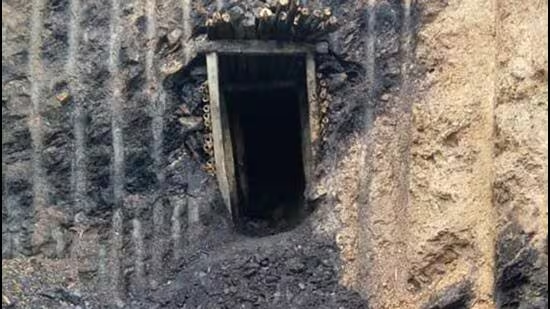
Thieves in Giridih, Jharkhand, dug a 2.5 km tunnel to steal lakhs of tonnes of coal. Learn about the incident, illegal mining crisis, and security measures to prevent coal theft.
Coal Theft in Giridih
Thieves in Giridih, Jharkhand, dug a 2.5 km long tunnel to steal lakhs of tonnes of coal. This operation continued from late night until early morning. While coal theft from collieries in Giridih is common, the scale of this particular incident, involving a 2.5 km tunnel, is notable.
Broader Context of Illegal Mining in Giridih
Illegal coal mining is a prevalent issue in Giridih, Jharkhand. Approximately 20,000 impoverished villagers in Giridih risk their lives daily by digging for coal in mines abandoned by Central Coalfields Ltd. (CCL). This activity is often a way of life in the town due to a lack of jobs. Around 5,000 bicycles are used daily to illegally transport coal out of CCL mines in Giridih.
Authorities have taken steps to address illegal mining by filling “rat holes,” which are illegal mining tunnels. For instance, on May 18, 2021, 31 illegal mining rat holes were filled at Bhadua behind CCL Hospital. More recently, on April 6, 2024, 26 illegal mines or rat holes were filled by JCB at the east side of a pumping station and an outsourcing patch.
Despite these efforts, incidents of mines caving in occur, sometimes resulting in fatalities. For example, in December 2024, a laborer was feared dead when an illegal mine collapsed near the Giridih opencast mines of CCL. The lack of substantial security officials from CCL contributes to the prevalence of illegal mining.
the main security measures being implemented to prevent such large-scale coal theft
Security measures to prevent large-scale coal theft include physical security enhancements, technological solutions, and collaborative efforts with law enforcement and local communities. Coal companies are responsible for providing necessary security measures and personnel to prevent coal theft.
Physical Security Measures
Physical security measures are critical to preventing unauthorized access and protecting assets at mine sites. Fencing and Access Control: Security at coal dumps has been strengthened through fencing, proper illumination, and round-the-clock guarding. Secure perimeter fencing with controlled entry points helps prevent unauthorized entry.
Check posts have been established at entry and exit points where all coal-laden vehicles are physically inspected. Additionally, concrete walls are erected at the entrances of abandoned mines to prevent access and illegal activities.
Deployment of Guards and Patrolling: Armed guards are deployed at railway sidings. Regular patrolling is conducted in and around mines, including overburden dumps. Joint patrolling with local police is also carried out in areas prone to pilferage. Security personnel equipped with body cameras can document illegal activities and share footage with law enforcement.
Surprise Checks and Re-weighment: Flying squads from the Central Industrial Security Force (CISF) and the security department conduct surprise checks and raids. Surprise re-weighment of coal-loaded trucks is perfor
Technological Solutions
Advanced technologies are being implemented to enhance surveillance, tracking, and overall security. RFID and GPS Tracking: Radio-Frequency Identification Device (RFID) based boom barriers and CCTV cameras are installed at weighbridges.
GPRS-based vehicle tracking systems with geofencing are used to monitor coal transportation. RFID technology is also used to control vehicles entering mine premises for coal loadingand to track personnel in real-time within mine sites.
- CCTV Surveillance: CCTV cameras are installed at strategic locations across all mines. An integrated surveillance system is utilized for monitoring mines and railway sidings. AI-powered video surveillance systems can detect suspicious activities and send real-time alerts to security teams.
- Electronic Fencing: Coal India is implementing measures to prevent theft by electronically “fencing” mining areas.
- SAP Systems: SCCL uses SAP as a cross-check measure in the transportation of coal.
- Collaborative and Administrative Measures Collaboration between coal companies, state authorities, and various task forces is essential for effective prevention.
- Intelligence Collection and FIRs: Intelligence reports about illegal coal depots and movement are collected and shared with district authorities for preventive action. Colliery Management and CISF regularly lodge FIRs with local police stations regarding theft incidents.
- Liaison with Authorities: Coal companies maintain close liaison with state authorities. Meetings are held at regular intervals with District Commissioners and other District Administrative Officials. The Central Coalfields Limited (CCL) management in Giridih has also held meetings with the Sub Divisional Magistrate (SDM) and Sub Divisional Police Officer (SDPO) to seek assistance in stopping coal theft and illegal mining.
- Task Forces: Committees or task forces are constituted at various levels (block, sub-divisional, district, state) in some subsidiaries of Coal India Limited (CIL) to monitor aspects of illegal mining.
- Holograms for Transportation: Challans for coal transportation by trucks outside the district are issued with holograms and signatures of authorized CISF officials to prevent pilferage.
Addressing Underlying Issues
Beyond direct security measures, there is an acknowledgment of the social and economic factors contributing to coal theft.
Community Engagement: Sustainable miners can develop strategies to address the underlying social and economic issues that support illicit mining. This includes raising awareness about the risks that reduced “life of mine” poses to the community, environment, and local economy. High unemployment rates and increased poverty can lead to illegal mining and infrastructure theft in unused shafts.
Job Creation: Rights activists advocate for more job creation to support a green and fair transition, addressing unemployment in mining hubs that fuels the illegal coal trade. Many impoverished families in mining hubs rely on digging for coal as their only income source.
FAQ’s
-
What happened in the Giridih coal theft case?
Thieves dug a 2.5 km long tunnel to steal lakhs of tonnes of coal from Giridih, Jharkhand, operating mainly at night.
-
Why is illegal coal mining common in Giridih?
High unemployment, poverty, and abandoned mines left by CCL push around 20,000 locals to risk their lives daily for coal mining.
-
What physical security measures are used to prevent coal theft?
Measures include fencing, access control, armed guards, joint police patrolling, and surprise inspections at weighbridges.
-
How is technology being used to stop coal theft?
Technologies like RFID boom barriers, GPS vehicle tracking, CCTV surveillance, and electronic fencing are being deployed.
-
What role do authorities play in controlling illegal mining?
Coal companies coordinate with local police, district officials, and task forces to conduct raids, close illegal mines, and file FIRs
-
Can job creation help reduce illegal mining in Giridih?
Yes, creating sustainable jobs and addressing poverty can reduce dependence on dangerous, illegal coal mining.