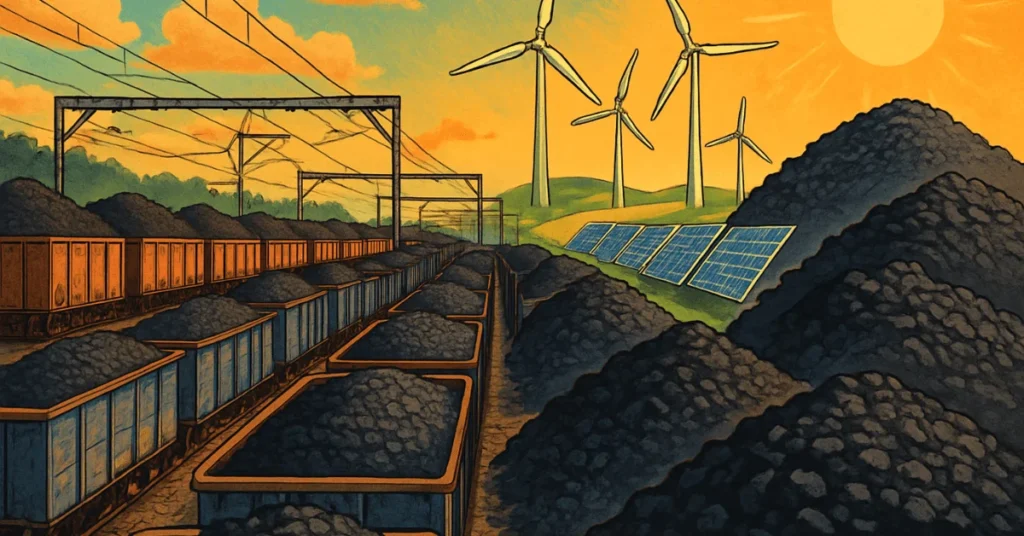
Discover the major hurdles in India’s coal transition. Explore financial needs, social impacts, policy reforms, and community perspectives as India moves towards cleaner energy.
India’s Coal Transition Must Overcome Many Challenges
The journey towards a cleaner energy future in India is complex, deeply intertwined with economic, social, and governance realities. In Jharkhand’s Nemra, the ancestral home of late Dishom Guru Shibu Soren, grief for a leader shares space with pressing administrative duties. Hemant Soren, the Chief Minister, exemplifies how governance and community sentiment are inseparable in coal-dependent regions.
Why India’s Coal Transition Is Critical
India needs an estimated $900 billion to $1 trillion for its power sector’s shift away from coal over the next three decades. This transformation is not only a financial challenge but also a human and political one, affecting millions of livelihoods and entire communities dependent on coal mining.
Key Challenges in Coal Transition
- Financial Burden: The massive investment required makes fund mobilization a primary obstacle.
- Social Impact: Millions rely on coal jobs; transitioning must include social support and job retraining.
- Policy Complexity: Streamlining regulatory frameworks and ensuring alignment across states like Jharkhand is vital.
- Community Engagement: Local perspectives, as seen in Nemra, must inform policy, blending grief for legacy leaders with hopes for sustainable development.
Governance and Human Stories
The scene in Nemra symbolises a broader reality: policymakers must balance emotional legacies with modernization. Rituals and mourning for Shibu Soren are ongoing, yet administration continues without pause, highlighting the sensitive mesh of past and present in India’s coal regions.
What are the main challenges India faces in its coal transition efforts
The main challenges India faces in its coal transition efforts are a combination of economic, social, infrastructure, policy, and governance hurdles.
Political and Institutional Challenges Political will is inconsistent, sometimes favoring coal due to employment and vote-bank politics in mining regions. Institutional reforms, like modernizing environmental assessment, enforcing labor protections, and ensuring accountability in mine allocations, remain incomplete.
Economic and Financial Challenges India needs massive upfront investment for renewable energy infrastructure, estimated in the hundreds of billions over the coming decades. Upgrading outdated grids, expanding transmission networks, and improving energy storage are essential but financially straining for state-owned power distributors (DISCOMs), which often have poor financial health and delayed payments.
Social Impact and Employment Coal-dependent regions, especially in states like Jharkhand and Chhattisgarh, face severe livelihood risks for millions of workers, many of whom are informal or contract laborers. Transitioning away from coal threatens communities with job losses, economic displacement, and negative health impacts without robust retraining, social support, and just transition policies.
Infrastructure Constraints The existing electricity grid is designed mainly for coal-based centralized generation and is inadequate for integrating intermittent renewable energy sources, requiring substantial upgrades in grid infrastructure and storage.
Policy and Governance Issues There is significant policy uncertainty, fragmented energy planning, and a lack of coordinated roadmaps at central and state levels. Regulatory complexities, uneven implementation of transition policies, and a focus on short-term energy security slow down decarbonization.
Energy Security Concerns India’s ongoing development needs and growing electricity demand make coal phase-out politically sensitive. There is also continued expansion of coal mines and power plants to ensure consistent energy supply, leading to a carbon lock-in and stranded asset risk.
Environmental and Health Impacts Coal mining regions experience high pollution, environmental degradation, and grave health conditions, disproportionately impacting marginalized communities (Scheduled Castes, Scheduled Tribes, and Other Backward Classes).
Logistical and Market Barriers Inefficient logistics—matching coal production centers with distant power plants—and transportation issues persist. Poorly designed energy markets, high costs of battery storage, and limited investor awareness further hinder renewable integration.
transportation and demand forecasting issues hinder India’s coal transition
India’s coal transition faces significant challenges due to inefficiencies in coal transportation and problems with accurately forecasting demand.
Transportation Challenges
- Congested Rail Networks: Indian Railways, the backbone of coal transportation, faces congestion due to ambitious plans to expand coal freight. Increases in coal transportation lead to slower train speeds, higher turnaround times for wagons (now averaging 3.9 days for coal wagons), and frequent cancellations of passenger and other freight trains in favor of coal movements. This strains the network and diverts resources from necessary upgrades, essential for modernizing India’s growing economy.
- Stranded Asset Risk: Investments in coal-specific rail infrastructure, particularly in sparsely populated areas, risk becoming stranded as demand for coal declines with the adoption of renewables. Such investments may not be justified in the long term if coal consumption drops, making current planning for coal evacuation less cost-effective.
- Road Transport Issues: Transporting coal by road is environmentally damaging and inefficient. Poor road conditions due to heavy truck traffic cause delays, increase dust and air pollution, and result in coal losses (“pilferage”). Locals sometimes block roads, further increasing transit times. The lack of dedicated coal highways and poor multi-modal coordination exacerbate these problems. Additionally, delays in loading, unloading, and lack of real-time integrated data across road, rail, and waterways make coal supply unpredictable.
Demand Forecasting Issues
- Rising, Yet Unpredictable Demand: India’s rapid economic growth drives increasing coal demand, but periodical supply crises and logistical disruptions make meeting this demand inconsistent. Demand forecasting must account for grid upgrades, renewables integration, and variability from regional and sectoral energy consumption patterns.
- Planning Mismatches: Forecasting errors cause either coal shortages (fueling power outages) or surpluses (leading to wastage and financial losses). Discrepancies between projected needs and actual consumption have strained infrastructure and created inefficiency. For example, overestimation of coal demand can prompt unnecessary investments in rail and logistics, escalating the risk of stranded assets when renewable additions accelerate.
- Integration Challenges: Demand forecasting is complicated by the need to integrate intermittent renewable sources. The centralized coal-based grid struggles to absorb variable solar and wind power, resulting in unused clean energy (“curtailment”), and making demand patterns harder to predict. Lack of real-time data and inter-state coordination further impedes flexible response to actual demand swings.
Impact on Coal Transition
The combined effect of transportation bottlenecks and inaccurate demand forecasts results in:
- Major delays in achieving a smooth and just coal transition for India.
- Inefficient resource allocation for both infrastructure and workforce.
- Higher emissions and pollution due to delayed adoption of cleaner transport methods and renewable energy.
- Opportunity costs for other sectors needing rail capacity and public funds.
Why does coal transportation congestion delay India’s clean energy goals
Coal transportation congestion delays India’s clean energy goals primarily by overburdening the rail network, diverting resources and capacity away from cleaner energy infrastructure and modern economic needs.
Network Bottlenecks: The Indian Railways, which handles the majority of coal freight, operates many lines at or above their maximum capacity—even after recent upgrades. Expansion of coal movement monopolizes critical track time, causing passenger and other freight trains—including those necessary for economic modernization—to be delayed or canceled, sometimes by thousands per year.
Opportunity Cost for Modernization: Prioritizing coal freight diverts planning, engineering, and public investment away from essential upgrades and infrastructure needed for a transition to cleaner energy. For example, rather than investing in grids for renewable power or efficient transport for other sectors, railway resources are focused on building coal-dedicated corridors.
Delayed Grid Integration for Renewables: Congested railways and the focus on coal supply slow the integration of renewable energy (such as solar and wind) into India’s national grid because those resources lack dedicated infrastructure investment and network space. Efficient electricity “movement over wires” is a technical substitute for moving solid coal, but rail resources remain locked in coal logistics.
Increased Pollution and Environmental Impact: Heavy reliance on transporting coal by road and rail increases dust, air pollution, and overall carbon emissions. Cancellations and rerouting of trains for coal also affect timely movement of goods and people essential to other green economic activities.
Systemic Delays and Inefficiency: Longer turnaround times for coal wagons (averaging up to 3.9 days) and unpredictable service interruptions reduce the railway’s overall capacity. This not only slows the coal supply chain but also delays broader infrastructure developments supporting clean energy.
Stranded Asset Risk: Investing billions in coal-only rail infrastructure risks locking India into outdated energy patterns. Should coal use decline or renewables expand, much of this infrastructure could become obsolete, hampering future energy transitions.
How Rail Infrastructure Limits India’s Coal Demand and Supply Balance
Congestion on Existing Rail Networks a significant portion of Indian Railways operates at or near full capacity, particularly on routes critical for coal movement. Heavy congestion means slower train speeds, longer turnaround times (averaging nearly 3.9 days for coal rakes), and frequent passenger train cancellations to prioritize coal transport. This crowds out other freight and decreases overall logistics efficiency.
Limited Expansion and Decongestion Projects While efforts like dedicated freight corridors (e.g., the Eastern Dedicated Freight Corridor) are designed to ease coal evacuation, many power plants remain unserved by these new corridors. Bottlenecks persist on routes from mining regions to major power generation centers, making full supply-demand alignment difficult.
Wagon and Track Capacity Constraints Coal India Ltd., for instance, has ambitious targets to increase coal transported by rail. However, most new output has moved by truck due to rail shortages. Increasing coal traffic requires more wagons and strategic unloading facilities, but these infrastructure upgrades lag behind growing demand.
Need to Nearly Double Transport Capacity Studies show that railways must increase coal carrying capacity from 660million tonnes to 1,200million tonnes annually by 2030 to meet power sector demand. Without this, coal shortages and electricity generation disruptions are likely, especially during seasonal surges.
Frequent Supply Interruptions Any aberration or delay in rail supply can have a domino effect, causing coal shortages at power plants and triggering widespread energy disruptions across sectors.
Stranded Asset and Opportunity Risks Heavy rail investments for coal-only corridors tie up capital in areas with declining long-term demand as renewables expand. This risks infrastructure becoming underused or obsolete, while other vital upgrades for modern freight or passenger services are delayed.
Strategic Responses
India is pursuing 38 priority rail projects to boost coal logistics, aiming to shorten transport distances, increase daily train allocations, and reduce supply costs—with some visible success in reducing delivered coal prices and improving reliability. Yet, full decongestion and seamless supply-demand balance require ongoing infrastructure upgrades, real-time supply chain management, and integration with automated “First Mile Connectivity” systems to further enhance efficiency and future-proof the network.
FAQ’s
-
Why does India need to move away from coal?
India must reduce its carbon footprint and meet global climate targets, requiring a shift to cleaner energy sources.
-
What are the major obstacles in India’s coal transition?
Financial constraints, social displacement, regulatory complexity, and the need for inclusive community engagement are top challenges.
-
What is the estimated cost of India’s coal transition?
The transition is expected to cost between $900 billion and $1 trillion over thirty years.
-
How are local communities affected by coal policy changes?
Communities, especially in coal-heavy states like Jharkhand, face job losses, cultural shifts, and require social support for reskilling.
-
What governance strategies are necessary for smooth transition?
Strong leadership, transparent policy reforms, and active local participation are crucial.






Hello team!
I came across a 151 awesome website that I think you should check out.
This tool is packed with a lot of useful information that you might find valuable.
It has everything you could possibly need, so be sure to give it a visit!
https://bizminton.com/why-iphone-is-better-than-android-smartphone/
Additionally do not neglect, folks, that a person at all times can in this particular publication locate responses to address your the absolute tangled inquiries. The authors made an effort to present all of the content using an very easy-to-grasp manner.
iixtc9